Sunday, 11 November 2007

Vendor liability & User Responsibility


We always hear this words "It is your responsibility" in case some one stolen money from your credited card or your password of your email.

Why we don't say the same words to software vendors if they have security vulnerability in their software make us lose a lot of money.

When we install any software, have to sign off EULA for software's vendor. But, we have to accept this license to install the software.
So, I think most of use tried to read this EULA agreement before sign it off. You could find a lot of EULA analyzer tools on the Internet could highlight the important points to you, such as Privacy, Vendor rights, your responsibility.

The point here, as long as we don't have any other options to install the software, the vendor must be liable of his software. By the end of last month, Symantec Web Security Response Webblog wrote about "
Privilege Escalation Exploit In the Wild", one week later they wrote a follow-up on this vulnerability. This vulnerability as written in "SECDRV.SYS Driver". Microsoft posted Microsoft Security Advisory (944653) about this vulnerability. Lets analysis the FAQ as posted in Microsoft Security Advisory (944653).

What is the scope of the advisory?

Microsoft is aware of a new vulnerability report affecting the Macrovision secdrv.sys driver on supported editions of Windows Server 2003 and Windows XP. This affects the software that is listed in the “Overview” section.

What is secdrv.sys?
The driver, secdrv.sys, is used by games which use Macrovision SafeDisc. The driver validates the authenticity of games that are protected with SafeDisc and prohibits unauthorized copies of such games to play on Windows. The secdrv.sys is included with Microsoft Windows XP, Windows Server 2003 and Windows Vista to increase compatibility of the games on Windows. Without the driver, games with SafeDisc protection would be unable to play on Windows. SafeDisc remains inactive until invoked by a game for authorization to play on Windows.

The question which raises here, If this vulnerability exploited and Microsoft customers lost millions of money, would Microsoft/Macrovision liable for this?. The answer is NO.

Lets have a look on "Windows Server 2003 End-User License Agreements", by using EULA Analyzer or read this EULA you could find

23. LIMITATION ON AND EXCLUSION OF DAMAGES. You can recover from Microsoft and its suppliers only direct damages up to the amount you paid for the software. You cannot recover any other damages, including consequential, lost profits, special, indirect or incidental damages.
This limitation applies to
  • anything related to the software, services, content (including code) on third party Internet sites, or third party programs; and
  • claims for breach of contract, breach of warranty, guarantee or condition, strict liability, negligence, or other tort to the extent permitted by applicable law.
It also applies even if
  • repair, replacement or a refund for the software does not fully compensate you for any losses; or
  • Microsoft knew or should have known about the possibility of the damages.
It is unfair if the customers lost millions of dollar and they can claim only the amount they paid for the software. Ira Winkler ;The author of Spies Among Us; wrote a wonderful article on this point with a title "Vendor liability: A pointless argument?". Also, Art Coviello , RSA's president, in last RAS Conference 2007 which held in London made this interview with ZDnet.

At the end I see the software vendor should be liable for their software as users responsible of their mistakes.

Thursday, 1 November 2007

Security Assessment Roadmap

In my last role with my ex-employer when my manager asked me to develop security assessment service. I made some Google search and I found the best way is to establish a framework, also because working under a formal process model make the task easy and development after that efficient,. I found the NSA developed INFOSEC Assessment Methodology (IAM). I started to read more about it and I found a brilliant book which helped me a lot from Syngress which is “Security Assessment: Case Studies for Implementing the NSA IAM”.

After that I started to use these resources to start to build our Security Assessment framework and I have just decided to share this information with my peers who interested in IT Security. Here is what I got.

Let’s assume we are going to make security assessment for company called “XYZ”


Introduction

XYZ company network may expose vulnerabilities to attackers in many ways. A key area is information exposure. Many details about XYZ Company that an attacker can gather can be used to assist in an attack. This includes technical data, such as what public services XYZ company offer, as well as Non-technical items, such as who your business partners are. The next area of importance is connectivity. Can attackers send and receive information to the systems within XYZ company network? This is dominated by the impact XYZ company s’ firewalls (and filtering routers) have on connectivity into XYZ company network, but it can also be affected by the controls XYZ company have in place to allow workstations and notebook computers to connect to XYZ company internal network. The last major area that needs to be examined is whether the services XYZ company network relies on contain exploitable vulnerabilities.

The roadmap for making security assessment consists of the following core phases with corresponding deliverables:

  1. Planning

Determine the scope of our assessment at XYZ Company. Decide how we will conduct it. Develop written rules of engagement to control the assessment and, most important, gain proper written approval to perform it. Assemble our toolkit to perform the assessment.

  1. Reconnaissance

Obtain technical and non-technical information on the XYZ Company and known public hosts, such as mail, web, and DNS servers…etc.

  1. Network service discovery

Determine which hosts and network devices at XYZ Company can be accessed from the outside. For each of these systems, determine what services are running on them.

  1. Vulnerability discovery

Probe externally accessible systems and remote services to determine whether they expose known vulnerabilities to the outside. Analyze initial results to eliminate false positives.

  1. Verification of perimeter devices

Evaluate firewall and router configurations at XYZ Company to ensure that they are well configured. Verify that firewalls at XYZ Company do not pass traffic that should be blocked. Verify that anti-discovery and anti-DoS controls are in place and work as expected at XYZ Company. Test intrusion detection/prevention sensors to ensure that they detect, log, and alert on suspicious activity.

  1. Remote access

Verify security controls of known remote access systems, including remote access servers, wireless access points, and VPNs. Search for unauthorized (rogue) modems and wireless access points at XYZ Company.

  1. Exploitation (optional)

Attempt to use exploitation techniques against the discovered vulnerabilities. Based on the goals of the test, this may be an iterative activity. Successful exploitation may lead to additional access on the network, which may open the opportunity up for further exploitation.

  1. Results analysis and documentation

Analyze discovered vulnerabilities to determine their overall effect on the level of risk to the network's security at XYZ Company. This is normally based on the vulnerabilities' impact to the affected system, the criticality of the system, the likelihood that the vulnerabilities will be exploited, and the effort required to remediate the vulnerabilities. Produce an assessment report that provides a list of prioritized vulnerabilities by level of risk and provides recommended steps to resolve the individual and root causes for the vulnerabilities.

  1. Recommendations

A final report will be compiled with recommendations and possible solution to be implemented at XYZ Company to leverage security and/or defend against breaches.


Reference: NSA & Syngress

Sunday, 21 October 2007

Facebook Safety - 1


I'm very interested with web 2.0. I red a lot of papers about the security challenges and Identity Management or what some call Identity 2.0

But I haven't finished my research yet. What I'm going to do is sharing some of the information which I have. I think this one will be first of coming Facebook security issues which I will try to raise here.

I choose a Facebook for reasons which are:

* Active users: 47 million (as of October 2007)
* Monthly new user average: 4 million
* Daily new user average: 150,000
* Page views: Over 15 billion per month
* Searches: Over 500 million per month
* Search index size: 200GB
* Largest networks: London, UK 1,268,000 and Toronto, Canada 859,000
* Traffic rank: 7th
* Photos: 1.7 billion (which averages to about 44 photos per user)

Also, on March 2, 2007, a poll conducted by eMarketer.com of American youths in the United States discovered Facebook was the most viewed site among all respondents with more females aged 17-25 (69%) visiting the site than males (56%). Try to check this and this also.

The fact here it become important to look at this service from security prospective. Alot of concerns such as Facebook Privacy Policy, Facebook opens profiles to public, Facebook Safety and Facebook Query Language.

My going articles will be just giving an example about security issues in Facebook. We will start by Facebook Safety.

Chris Kelly is Facebook's Chief Privacy Officer. He wrote on Facebook blog two days ago.

But right now, we want to make clear some of the things we are working on to prevent abuse from happening through Facebook. We are automatically moving complaints about nudity or pornography, and harassing or unwelcome contact to the top of our queue for Customer Support to address within 24 hours. We are limiting certain search functionality as it applies to minors. We are making sure that minors know explicitly when they are in contact with someone who is an adult.

Also, he added

As we continue to build out our proactive and reactive systems, we still believe that this is a partnership with you, our users. Practice smart internet safety; get to know our privacy options. Whether you're a minor or an adult, you should learn how to be smart online. No one wants anything bad to happen as a result of something on Facebook; we can all do our parts to make sure it doesn't.
So, I have decided to be smart online and made some google search on how to hack Facebook and I found a lot of links explain how to hack Facebook video application as an example. As facebook claims, the Facebook Video Application does not allow sharing videos outside of Facebook. Users will not be able to export or download videos from Facebook. But, the fact you can bypass this with a piece of cake. Userscripts.org has a very good article on how you could do this,you could check it. I tried it with my self and I downloaded my friends clips and some others. That means if bad guys got these clips he could modify it put some embarrassing things on it and resend to your friends.

That is explain you can't trust what Facebook claims, please watch this presentation.

Thursday, 18 October 2007

BC & DR Planning Tips


  • What’s the difference between disaster recovery and business continuity planning?

Disaster recovery is the process by which we resume business after a disruptive event. The event might be something huge-like an earthquake or the terrorist attacks on the World Trade Center-or something small, like malfunctioning software caused by a computer virus.

Given the human tendency to look on the bright side, many business executives are prone to ignoring "disaster recovery" because disaster seems an unlikely event.

Business continuity planning suggests a more comprehensive approach to making sure the business can keep making money. Often, the two terms are married under the acronym BC/DR.


  • What does a disaster recovery and business continuity plan include?

All BC/DR plans need to encompass how employees will communicate, where they will go and how they will keep doing their jobs. The details can vary greatly, depending on the size and scope of a company and the way it does business.

The critical point is that neither element can be ignored, and physical, IT and human resources plans cannot be developed in isolation from each other. At its heart, BC/DR is about constant communication. Business leaders and IT leaders should work together to determine what kind of plan is necessary and which systems and business units are most crucial to the company. Together, they should decide which people are responsible for declaring a disruptive event and mitigating its effects. Most importantly, the plan should establish a process for locating and communicating with employees after such an event. In a catastrophic event (Hurricane Katrina being a recent example), the plan will also need to take into account that many of those employees will have more pressing concerns than getting back to work.


  • How do I get started?

A good first step is a business impact analysis (BIA). This will identify the business's most crucial systems and processes and the effect an outage would have on the business. A BIA will help companies set a restoration sequence to determine which parts of the business should be restored first.Here are 10 absolute basics the plan should cover:

1. Develop and practice a contingency plan that includes a succession plan for your senior management.

2. Train backup employees to perform emergency tasks. The employees you count on to lead in an emergency may not be available.

3. Determine offsite crisis meeting places for top executives.

4. Make sure that all employees-as well as executives-are involved in the exercises.

5. Make exercises realistic enough to tap into employees' emotions so that you can see how they'll react when the situation gets stressful.

6. Practice crisis communication with employees, customers and the outside world, for example spoken person to the media.

7. Invest in an alternate means of communication in case the phone networks go down.

8. Form partnerships with local emergency response groups such as firefighters and police to establish a good working relationship. Let them become familiar with your company and site.

9. Evaluate your company's performance during each test, and work toward constant improvement. Continuity exercises should reveal weaknesses.

10. Test your continuity plan regularly to reveal and accommodate changes. Technology, personnel and facilities are in a constant state of flux at any company.


  • Is it really necessary to disrupt business by testing the plan?

Read this example which gives you an example of a company that thinks walk-through and paper simulations aren't enough. Preparedness test usually the cost effective test for your BC/DR plan.


  • What kinds of things have companies discovered when testing a plan?

- Some companies have discovered that while they back up their servers or data centers, they've overlooked backup plans for laptops.

- One company reports that it is looking into buying MREs (meals ready-to-eat) from the company that sells them to the military. MREs have a long shelf life, and they don't take up much space.

- The issue of where employees go immediately after a disaster and where they will be housed during recovery should be addressed before something happens, not after.

- USAA discovered that while it had designated a nearby relocation area, the setup process for computers and phones took nearly two hours. During that time, employees were left standing outside in the hot Texas sun. Seeing the plan in action raised several questions that hadn't been fully addressed before: Was there a safer place to put those employees in the interim? How should USAA determine if or when employees could be allowed back in the building? How would thousands of people access their vehicle if their car keys were still sitting on their desk? And was there an alternate transportation plan if the company needed to send employees home?


  • What are the top mistakes that companies make in disaster recovery?

1. Inadequate planning

2. Failure to bring the business into the planning and testing of your recovery efforts.

3. Failure to gain support from senior-level managers. The largest problems here are:

a. Not demonstrating the level of effort required for full recovery.

b. Not conducting a business impact analysis and addressing all gaps in your recovery model.

c. Not building adequate recovery plans that outline your recovery time objective, critical systems and applications, vital documents needed by the business, and business functions by building plans for operational activities to be continued after a disaster.

d. Not having proper funding that will allow for a minimum of semi-annual testing.


  • Can we outsource our contingency measures?

Disaster recovery services-offsite data storage, Hot site, Warm , Cold site, mobile site are often outsourced.

The type of offsite determined by recovery point objective (RPO) & recovery time objective (RTO).


  • How can I sell this business continuity planning to other executives?

The advice is to address the need for disaster recovery through Business Impact Analysis (BIA). Work with your legal and financial departments to document the total losses per day that your company would face if you were not capable of quick recovery. By thoroughly reviewing your business continuance and disaster recovery plans, you can identify the gaps that may lead to a successful recovery. Remember: Disaster recovery and business continuance are nothing more than risk avoidance. Senior managers understand more clearly when you can demonstrate how much risk they are taking."


  • How do I make sure the plans aren’t overkill for my company?

By implementing Business Impact Analysis (BIA) you could build effecitve and effecient BC/DR plan because the driven factor here is how much the copmany loss in case disaster or intruption of normal business processes. companies have to weigh the risk versus the cost of creating such a contingency plan.


Reference: CSO Online

Monday, 15 October 2007

Cyberwar race


I wanted many times to write about Cyberspace ware but I didn't have enough time to do this.

Lets review what happened for two months ago. On the BBC I red that the United Nation site hacked from hacktavism group. The speeches of the Secretary-General Ban Ki-Moon has been replaced with the following lines:

Hacked By kerem125 M0sted and Gsy
That is CyberProtest Hey Ýsrail and Usa
dont kill children and other people
Peace for ever
No war

After that I red also on the BBC's site about Estonia attack. It is consider the first Cyberwar.

For month ago I red on FT's site that Chinese military hacked into Pentagon.

Also, the last Black Hat USA 2007 in Las Vegas. The speech of Jim Christy was on Cyber Crime and he asked cooperation between Black Hat community and Governments.

And since 3 days ago the The Air Force Association (AFA) unveiled their report "Victory in Cyberspace".

have you noticed some thing from all of these events?

Yes, It is moving fast and became Hidden ware and that will have a lot of consequence things:

such as, selling security exploits as Wabi-sabi's auction site.

Security researchers/expert once find security vulnerability they prefer to sell it and I red story before I couldn't find its link again,once I get it I will post, for security researcher found IE vulnerabilities in IE and he tried to sell it and he did under condition which is this vulnerability applicable to certain version of MS Windows and IE. He didn't know the buyer but he guessed it is military agency.

He sold it with $80,000 upon his speech academic career will not make him gain this a mount of money.

Wednesday, 29 August 2007

Challenge-Response authentication isn't enough

I have a question raised in my mind since I came to UK. Why do banks still use challenge-response authentication as a identification on the phone.

What is Challenge-Response?

challenge-response authentication is a family of protocols in which one party presents a question ("challenge") and another party must provide a valid answer ("response") to be authenticated.

When I came to UK I tried to get Bank account and I got Bank account with one of the street banks in UK. But, I found they have a weak authentication system for their e-Banking service,like accept only alpha numeric characters as passcode, and their customer service staff using challenge-response to identify the caller.

Here is how they doing their Identification on the phone:

Customer Service (CS): Hello Sir., may I take your account number please.

Me: It is XXXX-XXXX-XXXX CS: How could I help you Sir? Me: I need ..... Please CS: May I know your surname please? Me: Galal CS: I'd like to go through some security questions with you before I process with your request. Me: Okay CS: What is your date of birth? Me: XX-XX-XXXX CS: what is your post code? Me: XXXX-XXXX CS:What is your house number please? Me:XXXXX CS: May I know what is the last transaction you did from your account,please? Me: I withdrawn £1 pound for 2 days ago. CS: That is enough sir, You have been identified and I will process with your request right now.

As we see, it is completely not enough to identify caller on the phone. Why?

Referring to “Identification & Authentication” blog you will know that identification should be combined with strong authentication process. Also,most of the asked questions could be gathered easily from many sources.

1- Social Engineering with your current employer to gather this information about you. 2- If you applied for voluntary work or any social activity as I did, they have most of these information. 3- from social sites like Facebook and Myspace...etc. 4- Threats raised after attacks on sites like Monster.com or other sites which contains users informations'.

But you may say to me , All of the above doesn't have the information about your last transaction.

Yes, you are right, But it's also could be compromised. How?!!

Well, By using some of social engineering techniques which explained well in “The Art of Deception” by Kevin Mitnick.

Using of challenge-response authenication is simple especially via phone and also easy for end users to have answers for the asked questions but it isn't enough to use it as the only method of identification nowadays.

Saturday, 25 August 2007

SELinux & Access Controls - 3

What is SELinux ?

SELinux was originally developed by the NSA. SELinux is an operating system based on Linux which includes Mandatory Access Control . With SELinux you can define explicit rules about what subjects ( users, programs ) can access which objects ( files, devices ). You could think of it as an internal firewall, which gives you the ability to separate programs and thereby ensuring a high level of security within the operating system. SELinux is implemented as a LSM, and utilises the LSM kernel interface.

So,What is LSM ?

SM ( Linux Security Modules ) is an extension of the Linux kernel which allows security systems to be easily added to the kernel.The LSM homepage is at lsm.immunix.org

Why should I run SELinux?

Because SELinux gives you the ability to secure processes from each other within the system. For example, if you have a web server on the Internet which is also serving Email and DNS then you would not want a vulnerability in the web server process allowing the attacker access to corrupt your DNS server. SELinux is one of the very few practical operating systems available which can provide such a level of protection.

What does SELinux do that others can't ?

In a conventional Unix/Linux system, access control is under the control of the user. The user choses the other users that may access the files that the user owns. SELinux is under the control of the security administrator. This includes the files that the user owns. Even if the user wants a specific other user to have access to a file, if that user is not in a domain containing the other user (ie, both are in the same domain) then the other user still cannot access the file. The difference is in mandatory access vs discretionary access. As far as the system files go, if all are carefully given approprate ACLs, then they can be protected. However, if the root accout is hacked, the files are still vulnerable. If a SELinux system is hacked, unless the hack itself contains an all powerful label/domain, the hack still doesn't have access to all of the files. Only those belonging to the domain of the hacked daemon.

How is SELinux works?

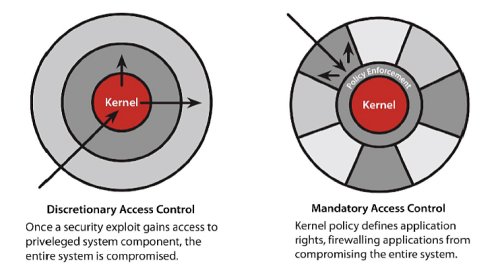
Security like file permissions or user account passwords are Discretionary Access Control (DAC) systems. They are referred to as “discretionary” because every object (files and directories) has an owner, access to objects is based on user identify, and users (the object owner or root) are able to–at their discretion–grant access to other users. In contrast, SELinux is a Mandatory Access Control (MAC) system. Access to objects is controlled by a system-wide policy, regardless of the ownership of any object, enforced by the kernel. Users, including the root user, cannot grant other users access to their objects in violation of the policy. Using a MAC security system requires a different mindset. When people first encounter a permission violation enforced by SELinux, they often try to diagnose the problem by checking the ownership of the file and the read/write/execute permissions on the object. But even if the ownership and permissions are correct, the access is still blocked. The user and file/dir ownership is not the deciding factor with SELinux, the policy is.

Why is this distinction important? Here’s an example. Let’s say that you’re running an http server for a retail web site paired with a mysql database containing customer data (including credit card information). The software that runs the web site has a security vulnerability. If someone breaks into the server, what’s the risk to your system? it’s just the web sever, right? Wrong! Suppose the attacker is able to obtain a root shell. With root on a non-SELinux system, he can access your credit card database. Once the attacker gains access through the web server, the whole system is at risk. If this same system was protected by SELinux, the user might be able to use the vulnerability to break into the web server, but he would be prevented from touching the database or any other parts of the system, even if he got a root shell. SELinux would only allow the http process to communicate with the database through the named pipe. In other words, with SELinux, you don’t trust the application–which may be buggy, insecure, or compromised–to secure itself. You rely on the SELinux policy.

This diagram illustrates the httpd web server example:

Fig 1. httpd web server example

SELinux provides security to a system in a way similar to a ship or submarine’s design. They are divided into multiple water-tight compartments. If the ship springs a leak in any one compartment, only that compartment will fill up with water.

The following diagrams illustrate this difference:

Fig 2. Discretionary and mandatory access control diagrams

Reference:

1- The UnOfficial SELinux FAQ

2- RedHat Magazine – SELinux step-by-step by Dan Walsh

3- NSA – what is new in SELinux